IOMETE in the 2025 Gartner® Market Guide for Lakehouses

IOMETE is featured in the 2025 Gartner® Market Guide for Data Lakehouse Platforms
What is a Gartner Market Guide - and why it matters
A Market Guide from Gartner is not a ranking or a purchase recommendation. Instead, it’s a map of a market - it defines the scope of a nascent or evolving category and outlines what customers should expect when evaluating vendors. It helps enterprises navigate complexity and sets the baseline for what “category membership” requires.
For IOMETE, being listed in the Market Guide for Data Lakehouse Platforms is more than a badge - it's confirmation that the lakehouse category has matured to the point where analysts are formally tracking it and defining its boundaries. For customers, this means lakehouse is no longer a fringe trend: it’s become part of the standard data-platform conversation.
What “lakehouse” means (per Gartner + IOMETE’s view)
In Gartner’s frame - and how IOMETE executes it - a data lakehouse brings together:
-
The scalability, flexibility and cost-effectiveness of a data lake (raw storage, open data formats, object storage)
-
With data-warehousing capabilities: structured tables, ACID semantics, data governance, SQL access, analytics readiness, and operational reliability
For many enterprises - especially those constrained by compliance, data sovereignty or long-term cost predictability - a self-hosted lakehouse becomes the logical sweet spot.
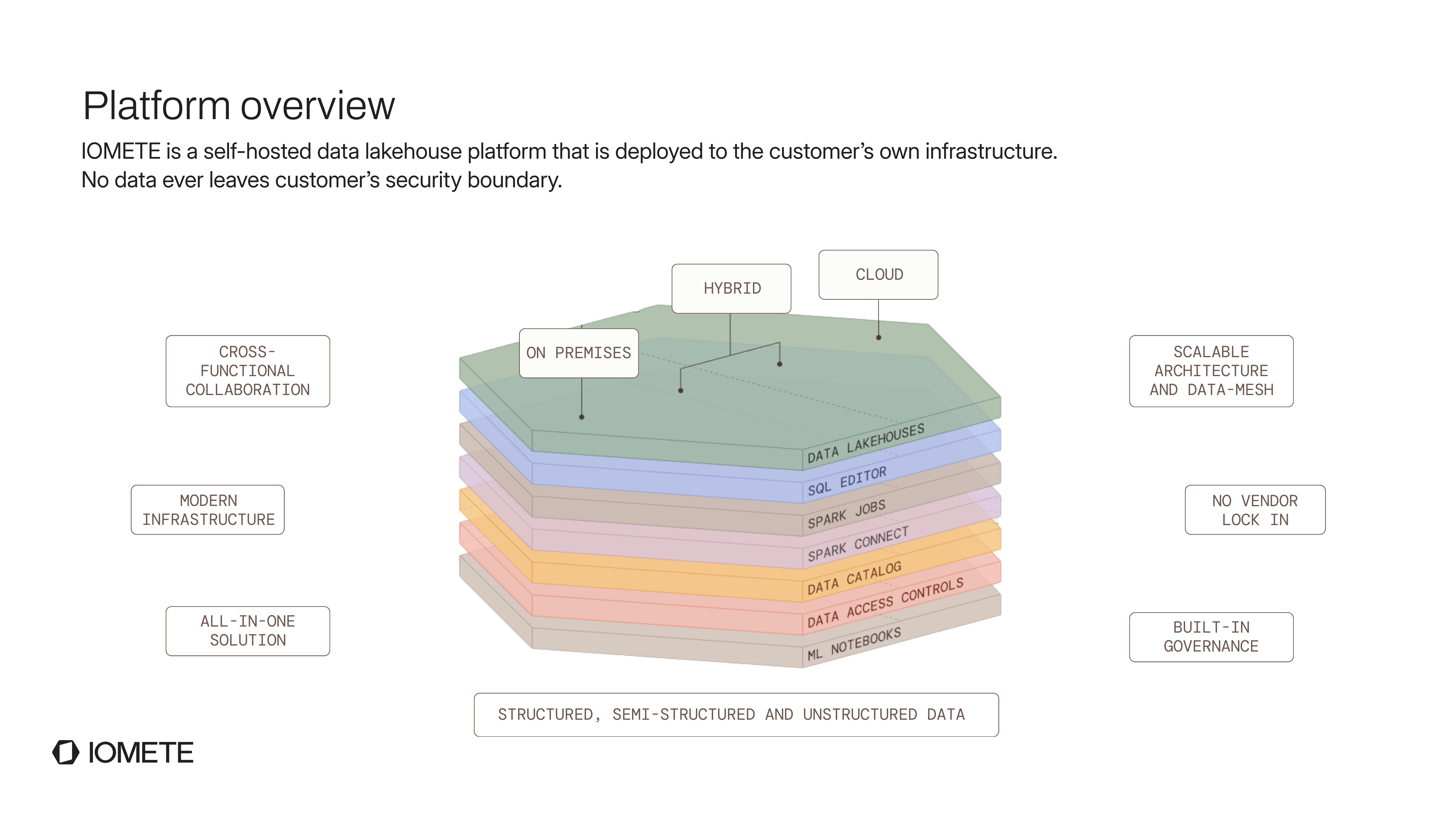
IOMETE delivers exactly that: a lakehouse platform that can run on-prem, in private cloud or hybrid environments - giving enterprises total control over data, performance, and cost, while avoiding vendor lock-in or SaaS-tax exposure.
What Gartner’s inclusion - and our inclusion - signals about the state of the market
- Lakehouse is not fringe
Gartner's decision to publish a Market Guide shows the lakehouse category has crossed a threshold: it’s no longer “emerging,” but “established enough to warrant analyst tracking.” That reflects real demand from enterprises balancing cloud-native architecture with sovereignty and compliance needs.
- Customers are asking for alternatives to public-cloud SaaS stacks
As data regulations tighten globally - and enterprises become more cautious about vendor lock-in - demand for self-hosted, hybrid-ready platforms is rising. IOMETE’s inclusion validates that self-hosting + lakehouse functionality is now considered a viable, mainstream segment.
- The playing field is broadening - but requirements are rising
Because Gartner defines core expectations for lakehouse platforms, vendors must deliver a certain set of capabilities (storage, governance, compute, compatibility with data workloads, etc.). Inclusion implies that IOMETE meets those baseline expectations.
- It’s now a buyer’s market - with options
With multiple vendors now qualifying under the lakehouse banner, buyers can choose based on their priorities: cost, sovereignty, on-premise vs cloud flexibility, compliance, support, performance, etc. As differentiation moves beyond “just cloud vs on-prem,” IOMETE’s value proposition - self-hosted lakehouse with enterprise-grade features - stands out.
What this means for enterprises evaluating a lakehouse
If you’re evaluating your next generation data platform, here are some questions Gartner’s Market Guide (and IOMETE’s logic) suggests you ask:
-
Do you need a vendor-agnostic data foundation - or are you okay with SaaS lock-in and cloud-native constraints?
-
Are compliance, sovereignty, performance predictability, data governance, and long-term cost under control?
-
Does your workload require flexibility: hybrid cloud, on-prem, cloud-migration-friendly architecture?
-
Do you want to avoid multiple silos (data lakes, data warehouses, ETL silos) and unify pipelines, storage, and compute under one roof?
-
Do you value future-proofing (data, AI, analytics, governance) over short-term convenience?
If the answer to many of these is “yes,” a self-hosted lakehouse platform built for enterprise constraints is a sensible bet.
Why IOMETE believes in this shift - and how we’re positioned
-
We build a truly self-hosted lakehouse: you control where your data lives and how it’s managed.
-
We support hybrid, private cloud, on-prem deployments - no vendor lock-in, no SaaS-tax.
-
We offer the performance, governance, and reliability enterprises expect from a “warehouse,” but with the flexibility of a “lake.”
-
With Gartner recognizing the category, we believe that the shift toward sovereign, controllable data infrastructure is becoming structural, not niche.
For enterprises facing regulatory pressure, data sovereignty demands, unpredictable cloud costs, or simply resistance to SaaS lock-in - IOMETE presents a standout choice.
Bottom line
IOMETE’s inclusion in the Gartner Market Guide for Data Lakehouse Platforms is a signal:
-
The lakehouse category is now mainstream.
-
Self-hosted and hybrid deployments are legitimate enterprise-grade options.
-
Buyers now have meaningful choice - and can evaluate vendors under a common definition.
If you care about control, compliance, cost-predictability, and flexibility, the lakehouse wave might just be hitting its stride.
Frequently Asked Questions
What is a Gartner Market Guide?
What is a data lakehouse platform?
What is a self-hosted data lakehouse?
How should enterprises evaluate a lakehouse platform for compliance and sovereignty?
Want to talk about how to evaluate IOMETE for your environment? Reach out - we’d be glad to walk you through a live demo or discuss your architecture.